“….The [live oak] timber is disappearing by exportation, by sales, and by clearing up the country for cultivation…. The woods are annually fired by the hunters and stock owners, and the young trees destroyed, so that if natural product is our dependence, we shall be, in half a century, without live oak enough to repair a vessel as the Constitution, and shall have to sell her ex necessitate. The time has now arrived when we must decide whether it is in the interest of the United States to resort to artificial culture [i.e., deliberately cultivate live oak], and plantations of live oak, or to do without them.”
– Congressman Joseph M. White, 1831
“Unless the full grown tree is to be cultivated, it is better, therefore, to cut it down when it is found on public lands, transport it to the navy yards, and put it away under sheds, or in ponds of fresh water, where it will keep a thousand years. The navy yard at this place [Pensacola, Florida] has ponds of fresh water, within two hundred yards of it, of sufficient size to contain a million of cubic feet…”
– H.M. Breckenridge, August 4, 1831
“Live oak timbers for the new framing were almost absolutely necessary. Where were they to be found? Almost providentially a supply was located immersed in Commodore’s pond Pensacola, Fla. The good luck that has always followed the Constitution was still with her in the matter of the precious live oak: the supply in Florida was sufficient in quantity and in suitable sizes.”
– Commander Louis J. Gulliver, 1931
In 1800, confronted with the virtual extinction of appropriate shipbuilding lumber, a group of navy officers responsible for the maintenance of the USS Constitution decided that a stock of the best available timber would be sunk in a freshwater pond in Pensacola, Florida, where anaerobic conditions would preserve it for ‘for a thousand years.’ A century later, in yet another period of scarcity, this wood was rediscovered, and the shipwrights’ forethought was celebrated.
The process of planting, forgetting, and remembering is documented in contemporary letters, demonstrating the precarious social nature of the knowledge on which the preservation of the vessel hinged, and the immediate mythologization of the sequence of events that was afforded by the passing of a century between sinking and unearthing.
Image credits: Creasman et al.
In the Charlestown Navy Yard, similar practices of preserving timber for the future were used, and in 2008, construction excavations uncovered a forgotten timber pond buried under the silt. Workers found hundreds of timbers dated back as far as the sixteenth century. Even more fascinating than the wood was the discovery of a system of accounting engraved into each timber, containing information related to the timber’s origin and its material properties – a progenitor of the contemporary barcode, or material passport.
In a manner similar to the contemporary moment, this technology evolved from scarcity – a lack of abundance, and a need for specific material properties spurred precise methods of accounting, and a culture of building that always considered the future. This resulted in specific building practices, for example the practice of procuring double for the provision of one – oftentimes, when an element was made out of a specific piece of timber, an identical piece would be sunk in anticipation of future repairs.
The unearthing of the ancient timber pond also presents a confrontation with the gradual obsolescence of sociotechnical value systems. As shipbuilding transitioned from wood construction to steel, the timbers, and the systems of accounting and preservation that underpinned them, were forgotten.
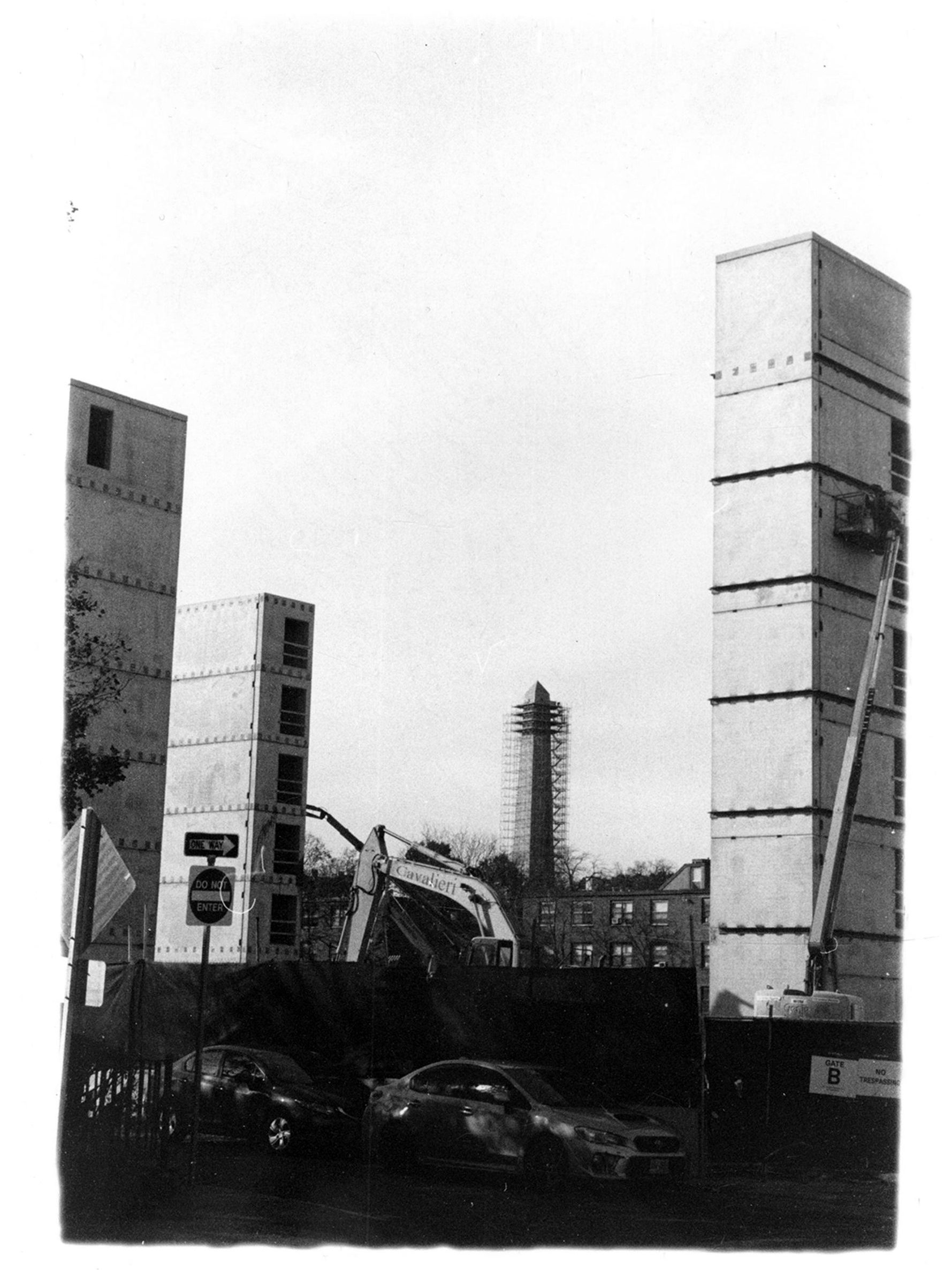
Today, we are witnessing the same pattern in the built environment, with inflexible and wasteful systems being demolished and buried in landfills after mere decades of lifespan. As these structures are broken open, they reveal their origins in value systems that do not consider the future.
Sadly, due to a degree of both inertia and social apathy – these systems used in building do not adapt quickly, and their replacements more often than not display the same shortfalls.
How could buildings embed these systems of knowledge and practices within the fabric of their construction – encoding values of circularity that endure beyond horizons of human attention?


 Inge Donovan | Portfolio